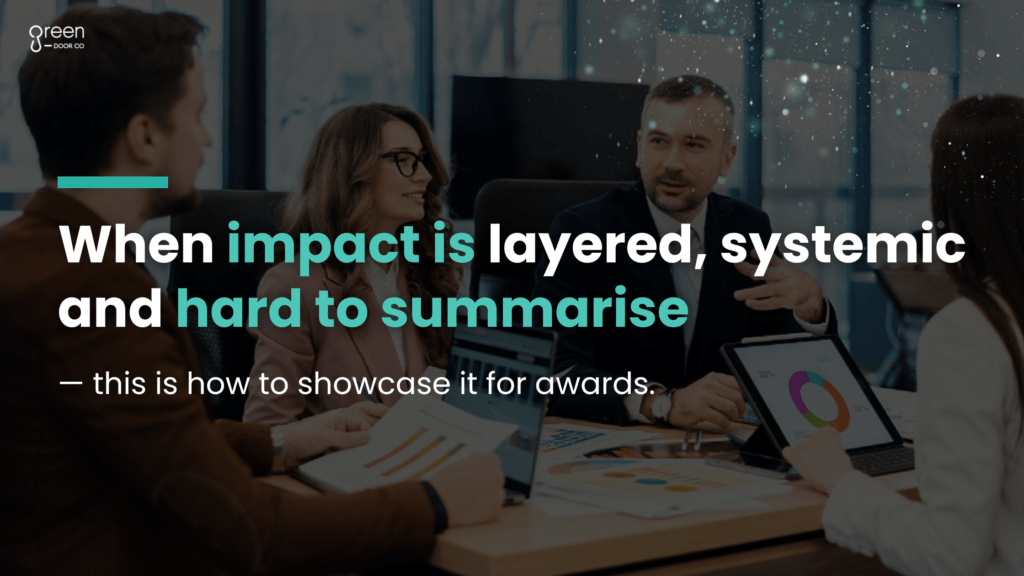
If you work in sustainability, diversity or innovation, chances are you’ve had this thought before: “What we do matters — but it’s hard to explain.”
That tension sits at the heart of what we see every day in business awards work. The most meaningful projects are often the most complex, layered and interconnected. They don’t reduce neatly to a single metric or a catchy sentence. And yet, these are exactly the kinds of initiatives judges want to recognise.
This is what we call the impact paradox. Complexity isn’t a weakness. It’s a sign of depth. The challenge isn’t that your work is “too complex” to win an award, it’s that it needs a translator.
Start with the “why”, not just the “what”
Many submissions fall into the same trap: they meticulously describe what was done. Solar panels installed. New hiring frameworks introduced. Software deployed.
What judges are really assessing, however, is why it mattered.
Strong award storytelling moves beyond activity and into transformation. Instead of listing initiatives, show the before and after. What problem existed? What wasn’t working? And what changed as a result of your decision to act?
A diversity program, for example, isn’t just about representation metrics. It’s about how decision-making shifted, whose voices were amplified, and how that changed outcomes across the business.
Get past the buzzword barrier
Terms like circular economy, intersectional equity or systems innovation are important. They’re also easy to skim past when you’re judging your tenth entry of the night.
A practical rule we use is the “barbecue test”: if you couldn’t explain your impact to a neighbour at a BBQ in two sentences, it’s too complex for an award entry.
This doesn’t mean dumbing things down. It means translating expertise into clarity. Jargon should support understanding, not replace it.
Data is the skeleton. Story is the skin.
Numbers matter. Evidence matters. But data alone doesn’t persuade — it verifies.
Think of data as the skeleton that holds your story upright. The narrative is what gives it shape and life. Judges want proof of results, but they’re also looking for judgment, resilience and intent.
Research consistently shows that decision-makers respond more strongly to narratives that demonstrate long-term vision, not just short-term wins. A strong entry weaves quantitative results with qualitative insight.
Show the ripple effect
Impact rarely stops where it starts.
A sustainability initiative might reduce emissions directly, but it can also influence supplier behaviour, attract aligned customers, and strengthen employee engagement. A diversity program might begin with hiring, but flow into better products, stronger governance and deeper trust.
Mapping primary, secondary and tertiary impacts helps judges see the full value of your work — especially when the most powerful outcomes aren’t immediately visible.
Don’t polish away the truth
Overly perfect stories can work against you.
Judges are experienced professionals. They know real change is messy. Sharing what didn’t work (and what you learned) often builds more credibility than a flawless narrative.
An innovation that failed before it succeeded, or a sustainability target that had to be recalibrated, signals maturity. Transparency shows you understand your own impact, not just how to market it.
Think beyond the trophy
Awards aren’t just ceremonial. They function as a third-party signal of credibility.
For businesses navigating growth, investment or talent acquisition, awards act as shorthand for trust. They reassure stakeholders who don’t have time to dig deeply into your operations. They also matter internally — recognition boosts morale and retention, especially for teams working on long-term or emotionally demanding initiatives.
This is why awards should be treated as strategic assets, not vanity projects.
Write for the judge’s reality
Judges are time-poor and often reading across multiple categories. Complex impact needs signposting.
Use clear subheadings. Break dense ideas into bullets where appropriate. Make it easy for someone skimming to grasp your contribution quickly, then choose to read deeper.
Clarity is a competitive advantage.
Evidence lives beyond spreadsheets
Not all proof is numerical.
Consider including artifacts of impact: a short testimonial, screenshots of user feedback, or photographs from the field. These details ground your story in reality and signal that the work is lived, not theoretical.
See how SignManager won two of Australia’s most influential business awards and cemented its position as an industry leader.

Anchor your work in global language
For sustainability and diversity entries, alignment with recognised frameworks can help judges quickly contextualise your impact.
Referencing the United Nations Sustainable Development Goals gives your work scale and legitimacy. Similarly, frameworks from the World Economic Forum or benchmarks like the B Corp Impact Assessment provide a shared language for impact.
Where specialist support makes the difference
Extracting clarity from complexity is a skill.
Just as businesses engage experts for legal or financial work, award storytelling benefits from an external lens. The role of a specialist agency is to ensure the soul of the work isn’t lost in the technical detail.
At Green Door Co, we work with organisations doing meaningful, hard-to-summarise work — and help translate it into award submissions that are clear, credible and compelling.
If you’re doing work that matters but struggling to articulate its full impact, a conversation can help uncover the story already there.
Reach out to Green Door Co to explore how your sustainability, diversity or innovation story could be positioned for awards — without oversimplifying what makes it valuable.